
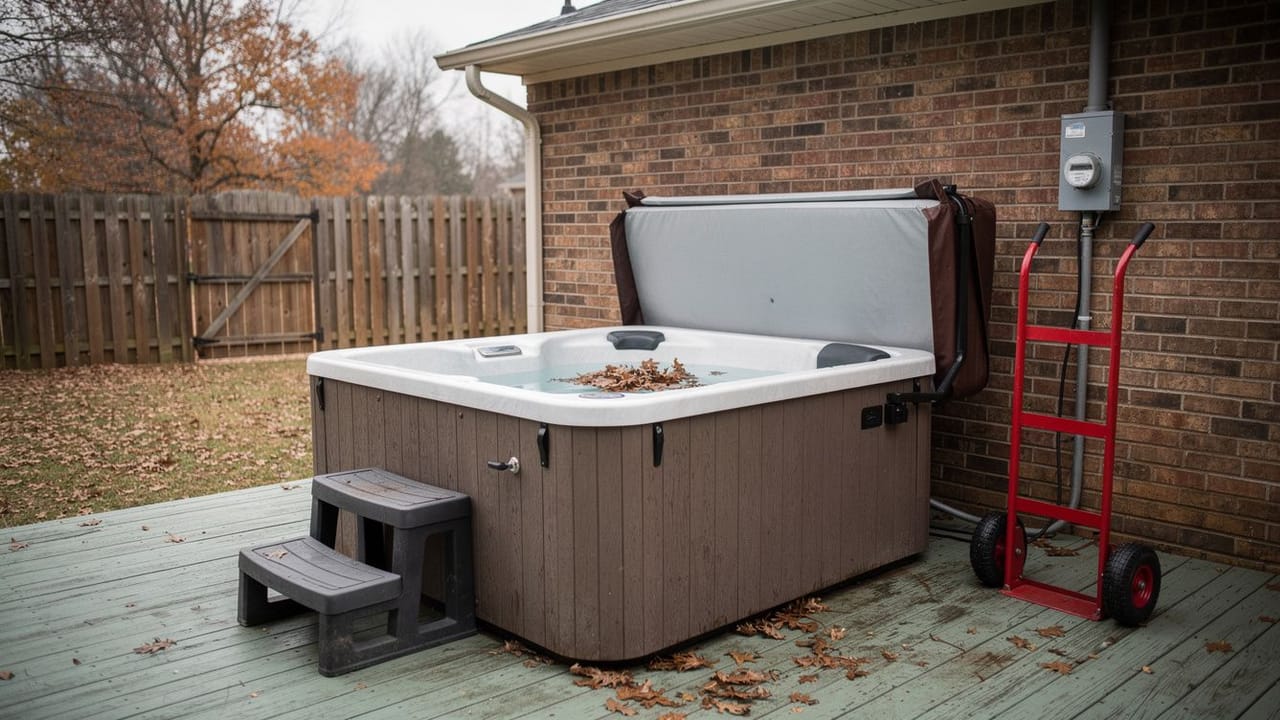
· by Michael Blair, Nashville's Junk Removal
A hot tub is one item, but it takes more planning than most of what we haul from a house. It is heavy even empty and heavier with water still in it, it usually sits where someone wanted privacy rather than a clear path to the driveway, and unless it is a plug-in model it is wired into the house, which has to be dealt with before anyone touches it. Done in the right order it is a morning. Done in the wrong order it is a hazard. Our page on hot tub, shed and playset removal covers the service itself; this post is about getting a dead tub ready to go.
The electrical comes first
When someone books a hot tub with us, the first thing we ask is how it gets power: a cord to an outlet, or wiring run to a disconnect box near the tub and back to the breaker panel. If it is wired in, the power has to be off at the breaker and at the disconnect, and the wiring at the tub disconnected and made safe, before it moves. We ask that a licensed electrician do that and cap the conductors at the disconnect, or take the circuit back to the panel if no tub will use it again.
Licensing and permits are the electrician’s side of it. The state’s Limited Licensed Electrician license covers work under $25,000 a project, and the Board for Licensing Contractors tells electricians to check first whether the local government accepts that license or has its own requirement for permits and inspections. In Nashville, electrical trade permits go through Metro Codes, whose trades permits page says only licensed contractors with an e-permit account can apply online, and anyone else applies in person at the Department of Codes and Building Safety. Whether taking out a hot tub circuit needs a permit is a question for your electrician or Codes, not for us.
Our crews do not cut into wiring, live or not. Have the electrical done a day or more ahead, and tell us it is finished when you book. If the tub is still connected when we arrive, we reschedule rather than work around it.
How should a hot tub be drained before removal?
Drain it fully, lines included. A submersible pump or the drain valve takes care of the shell, and a wet vacuum pulls out what is left in the lines and the footwell. Any water still inside adds weight and ends up on the floor if the tub has to come through the house. Where the water goes matters too. Metro Water Services’ pollution prevention page says only rain belongs in the drain, and Metro’s Illicit Discharge Ordinance makes environmentally hazardous dumping illegal and violators subject to a fine.
A storm drain is not a sewer line to a treatment plant. The Metro stormwater division says stormwater receives no treatment before it is released into the environment, and the EPA’s page on municipal storm sewer systems describes polluted runoff being discharged untreated into local water bodies. Neither page names hot tub water, so before draining a tub that still has sanitizer in it, call Metro Water Services and ask where it should go. The stormwater page lists 615-880-2420 for pollution concerns on weekdays.
Then the route. A tub that was lifted onto a deck, or carried through a gate that has since been fenced in, needs the same kind of access going out. We either tip it on its side and walk it out on a dolly with enough people to control it, or cut it into sections with a reciprocating saw, which is how we handle a tub that is going for scrap anyway. Cutting is messy and loud, but it is quick, and it turns one heavy lift into pieces two people can carry.
- Electrical disconnected and made safe by an electrician
- Shell and lines drained, and the water sent somewhere Metro allows
- Clear route to the truck, gates measured, deck steps checked
- Decide whether it goes out whole or in sections
Sell, donate or scrap
If the tub still runs, it may be worth listing before you pay anyone to haul it. Whoever takes it gets the same moving problem you have, so say in the listing where it sits, how far it is from the driveway and what is in the way. A tub that runs but needs a pump or a heater might interest someone who repairs them. One that has sat dead for years, with a cracked shell or a rotted cabinet, is unlikely to find a taker, and waiting for one can cost you a season.
When we take a dead tub, the cover comes off first, since it is foam in a vinyl skin and goes separately. We pull the pump motor, the heater and any copper for scrap, and the shell and cabinet go to the landfill. Where something can be donated or recycled, our donation and recycling service explains how we sort a load, and our post on donating, recycling or disposing goes through the rest of a household the same way.
What is left once the hot tub is gone?
Under the tub is a pad or a patch of deck that has been shaded and damp for as long as the tub sat there. On a wooden deck, we look at those boards before anyone puts weight on them, because wood that never got a chance to dry out may not be sound. A concrete pad will probably show exactly where the tub was. Plan on a repair or a refinish, and on the electrician removing the disconnect box and conduit or capping them neatly.
If a new tub is going in, ask the dealer what it needs before you order: the electrical, what it will sit on, and how it gets to the spot. Expect the removal and the delivery to be separate visits, and we only do the first one. Our crews work across Nashville and Davidson County and the towns around it, and if you have a tub ready to go, ask us for a free estimate and tell us what stands between it and the driveway.
Sources
- Metro Nashville Water Services, Pollution Prevention — Only rain belongs in the drain; the Illicit Discharge Ordinance makes environmentally hazardous dumping illegal and violators subject to a fine
- Metro Nashville Water Services, Stormwater — Stormwater receives no treatment before it is released; pollution concerns line 615-880-2420, Monday to Friday
- US EPA, Stormwater Discharges from Municipal Sources — Runoff through municipal storm sewer systems is often discharged untreated into local water bodies
- Tennessee Board for Licensing Contractors, Limited Licensed Electrician — The LLE license covers work under $25,000 per project; check with the local government on permits and inspections
- Metro Nashville Codes and Building Safety, Trades Permits — Electrical trade permits; only licensed contractors with an e-permit account apply online, others apply in person
FAQ
Getting Rid of a Hot Tub That No Longer Runs — questions
Can a junk removal company take a hot tub?
We do. If it is wired in, an electrician needs to disconnect it and make the wiring safe first, and the tub should be drained. Then we either walk it out whole or cut it into sections for the truck, depending on the route and whether it is going for scrap.
Do I need an electrician to remove a hot tub?
If the tub is hard-wired, yes. We ask that a licensed electrician disconnect it at the tub and cap or remove the circuit at the disconnect box, because our crews do not cut into wiring. Whether that work needs a permit is a question for the electrician or your local codes office.
Is an old hot tub worth anything?
A working one may sell if the buyer is willing to move it, and one that needs a pump or heater may interest someone who repairs them. One that has been dead for years with a cracked shell or rotted cabinet is unlikely to sell. When we haul one, the pump motor, heater and copper go for scrap and the shell and cabinet go to the landfill.
How do you take apart a hot tub?
Once it is disconnected and drained, the cover comes off first, since it is foam in a vinyl skin and goes separately. We cut the tub into sections with a reciprocating saw, pull the pump motor, heater and any copper for scrap, and carry out pieces small enough for two people to handle.